Beagle Field Trials Explained
What They Are and Why They Matter
Jeff Davis | https://hounddogcentral.com
 0
0 0
0 0
0 0
0 0
0
If you have ever stood along the edge of a briar patch at daylight and listened to a pack of beagles open on a rabbit track, you already understand why field trials hold such a grip on houndsmen. There is nothing polished or artificial about a good beagle working scent in rough cover. A field trial is simply a structured way to measure that work. For newcomers, though, the language, the formats, and the judging can feel like a world of their own. I have spent enough mornings behind rabbit dogs to tell you that once you understand the purpose of a trial, the whole thing starts making sense.
At their best, beagle field trials are about preserving hunting ability. They are not dog shows in the usual sense, and they are not built around looks alone. The focus is on performance in the field, where a hound must use nose, brains, desire, line control, and honest rabbit sense. Whether you are thinking of entering your own beagle, watching your first cast, or trying to understand what titles on a pedigree really mean, it helps to know what these events are meant to reward.
What a Beagle Field Trial Is Really Testing
A beagle field trial is a competitive event where beagles are judged on how they pursue rabbit scent under set rules. The dogs are expected to search for game, strike a line, move it forward, recover checks, and account for the rabbit in a way that shows control and determination. Different registries and formats may emphasize slightly different traits, but the central question stays the same: can this hound hunt like a true rabbit dog?
That distinction matters. A flashy dog that barks hard and tears through the cover may impress someone who is new to hounds, but experienced judges are usually looking deeper than noise and speed. A useful beagle must move the line forward without cheating, over-running badly, or causing needless breakdowns. The dog should contribute to the pack, not simply stir up confusion. The best trial hounds are the kind hunters enjoy following on frosty mornings because they produce game honestly.
In practical terms, judges are studying nose, search, line control, check work, drive, cooperation, and endurance. They want a hound that hunts with purpose, not one that has to be begged into cover. They want clean work on the rabbit line, not wild swinging. They want enough foot to keep the chase moving, but not so much reckless speed that the track falls apart every hundred yards. Good beagle work has rhythm to it, and a good field trial tries to identify which dogs can keep that rhythm under pressure.
Different Trial Formats and Why They Matter
One thing that confuses many dog owners is that "beagle field trial" does not always mean the same thing everywhere. Different organizations run different styles, and each style tends to favor a certain kind of hound. That is why one person may praise a hard-driving dog while another talks about tighter line control and patient check work. They may both be talking about excellent beagles, just under different standards.
The American Kennel Club, the United Kennel Club, and other associations each have established formats. Within AKC events alone, you may hear about Large Pack, Small Pack Option, Midwest, or brace-influenced lines in older discussions. Some formats reward a more conservative, line-minded dog. Others allow a stronger pace and more competitive pack action. A newcomer should never assume that a trial champion from one format will work exactly the same as a winner from another.
That is not a criticism of the sport. It is simply reality. Rabbit scenting conditions change by region, cover changes by region, and hunter preferences change too. A beagle built for cottontails in tight, thorny cover may not look exactly like one favored in a different trial circuit. The smartest thing any owner can do is watch several events, talk to handlers, and learn what style fits the kind of hunting they actually do.
Pack Work Versus Individual Impression
Most field trials place dogs in braces or packs so judges can compare them in action. This is important because rabbit hunting is rarely a solo exercise. Beagles must work among other dogs without quitting, fighting, skirting, or creating chaos. A hound may look decent by itself in a training pen or on a short run at home, but when dropped with unfamiliar dogs, the truth comes out quickly. Pack pressure exposes weaknesses.
Judges watch how each dog contributes. Does it hunt independently when needed? Does it hark in honestly when another dog has the line? Does it claim checks it did not solve? Can it maintain the rabbit's line without rough handling? A smart, balanced beagle often stands out over time, especially when scenting gets tough and the race stops being simple.
How Judging Works in the Field
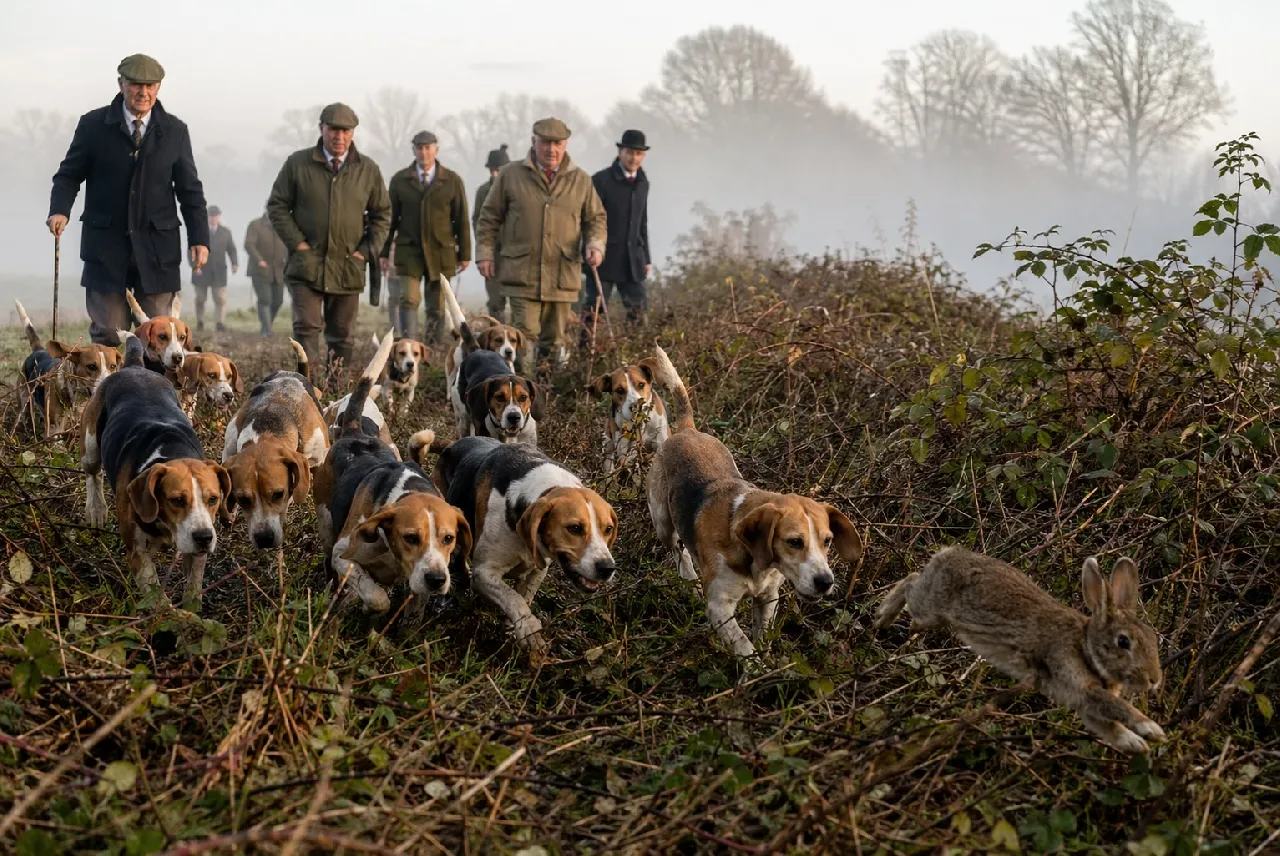
To the untrained eye, judging can seem mysterious. A cast of dogs disappears into cover, handlers and gallery trail behind, and judges move with a kind of practiced urgency. But there is structure to it. Judges are trying to stay close enough to see how the line develops, where the breakdown happens, and which dog honestly recovers the track. They listen hard, watch body language, and piece together what happened in seconds that can make the difference between a placement and a pickup.
When a rabbit is jumped, the dogs are expected to pursue the scent line forward. If the line breaks down, the dogs work to recover it. This is where many trials are won. Plenty of hounds can run when scent is easy and the rabbit is making a clean path through open cover. The better hounds show themselves when the rabbit doubles back, cuts through bare ground, or loses the pack in thick tangles. In those moments, patience, nose, and brains count more than noise.
Faults can include quitting the hunt, excessive mouth when no line is present, rough running, failing to search, or interfering with the pack. The exact language depends on the rulebook, but the idea is consistent. Judges are not just rewarding excitement. They are sorting useful rabbit hounds from dogs that only look impressive for short stretches.
Why Field Trials Matter to Hunters and Owners
Some people hear the word "trial" and assume it is a game for ribbons and bragging rights. There is certainly some pride involved, as there is in any working-dog competition, but good field trials serve a bigger purpose. They help identify breeding stock that can do the job hounds were developed to do. That matters not just to competitive handlers, but to ordinary beagle owners who want a dog with real instinct and trainability.
A titled dog is not automatically the perfect rabbit hound, and a non-titled dog is not automatically inferior. Any seasoned hunter knows that. Still, field trial records can provide valuable clues. If a pedigree includes generations of dogs proven under field conditions, there is a better chance the line carries the traits most hunters value. Search, nose, line honesty, and grit are not accidents. They are preserved when people continue to test for them.
There is also a cultural side to trials that should not be overlooked. These events bring together folks who care about hounds. You hear old stories, compare bloodlines, watch young dogs grow up, and learn to tell the difference between empty commotion and real rabbit work. For someone new to hound dogs, a trial can be one of the best classrooms in the world if they show up willing to listen.
What to Expect if You Attend Your First Trial
Your first beagle field trial may feel a little overwhelming, mostly because the pace changes fast. There will be periods of standing around, talking dogs, and waiting on casts to be drawn. Then all at once everyone is moving through wet grass, dodging blackberry canes, and trying to stay close enough to hear a race unfold. Bring good boots, keep your mouth shut more than you talk, and pay attention to the older handlers who know when a pack is honest and when it is just making music.
Do not expect every minute to be dramatic. Sometimes scenting is poor. Sometimes rabbits do not move well. Sometimes a promising pack falls apart because one dog cannot hold the line. That, too, is part of the lesson. Field trials are not staged performances. They are at the mercy of weather, cover, rabbits, and hounds, just like a real hunt.
If you are thinking about entering a dog, be honest about what you have. A field trial is a fair way to learn your beagle's strengths and faults, but it can be a harsh teacher. Dogs that dominate the backyard may not show much when strange cover, new dogs, and competition are added. That should not discourage you. Many fine hounds needed time, handling, and maturity before they were ready to prove themselves.
Training and Preparation Before Entering
A dog does not need to be perfect before attending a trial, but it should be physically fit, obedient enough to handle, and experienced on rabbits. Condition matters more than many first-time owners realize. A beagle that tires quickly or loses focus after a short race will not show its best qualities. Time in the field, not wishful thinking, is what prepares a dog for trialing.
It also helps to know the format you are entering. A hound suited to one style may struggle in another. That is why experienced beaglers often talk about matching the dog to the trial format instead of forcing the dog into a system that does not fit its natural strengths.
Final Thoughts on Beagle Field Trials
Beagle field trials are easiest to understand when you stop thinking of them as abstract competitions and start seeing them for what they are: organized tests of rabbit hounds. A good trial should reward the same qualities that make a beagle worth feeding all year long. Honest search, clean mouth, line control, check ability, heart, and the drive to keep a rabbit moving through difficult country are what matter in the field, and they are what matter in trialing too.
For dog owners interested in hound dogs, learning about field trials opens a door into the working side of the beagle world. Even if you never enter a dog, watching a few casts will teach you more about true hound ability than a dozen sales ads ever could. And if you do choose to step into that world, do it with open eyes. Listen carefully, hunt often, and let the dogs show you the truth. In the end, the rabbit and the cover have a way of exposing everything worth knowing.
At their best, beagle field trials are about preserving hunting ability. They are not dog shows in the usual sense, and they are not built around looks alone. The focus is on performance in the field, where a hound must use nose, brains, desire, line control, and honest rabbit sense. Whether you are thinking of entering your own beagle, watching your first cast, or trying to understand what titles on a pedigree really mean, it helps to know what these events are meant to reward.
What a Beagle Field Trial Is Really Testing
A beagle field trial is a competitive event where beagles are judged on how they pursue rabbit scent under set rules. The dogs are expected to search for game, strike a line, move it forward, recover checks, and account for the rabbit in a way that shows control and determination. Different registries and formats may emphasize slightly different traits, but the central question stays the same: can this hound hunt like a true rabbit dog?
That distinction matters. A flashy dog that barks hard and tears through the cover may impress someone who is new to hounds, but experienced judges are usually looking deeper than noise and speed. A useful beagle must move the line forward without cheating, over-running badly, or causing needless breakdowns. The dog should contribute to the pack, not simply stir up confusion. The best trial hounds are the kind hunters enjoy following on frosty mornings because they produce game honestly.
In practical terms, judges are studying nose, search, line control, check work, drive, cooperation, and endurance. They want a hound that hunts with purpose, not one that has to be begged into cover. They want clean work on the rabbit line, not wild swinging. They want enough foot to keep the chase moving, but not so much reckless speed that the track falls apart every hundred yards. Good beagle work has rhythm to it, and a good field trial tries to identify which dogs can keep that rhythm under pressure.
Different Trial Formats and Why They Matter
One thing that confuses many dog owners is that "beagle field trial" does not always mean the same thing everywhere. Different organizations run different styles, and each style tends to favor a certain kind of hound. That is why one person may praise a hard-driving dog while another talks about tighter line control and patient check work. They may both be talking about excellent beagles, just under different standards.
The American Kennel Club, the United Kennel Club, and other associations each have established formats. Within AKC events alone, you may hear about Large Pack, Small Pack Option, Midwest, or brace-influenced lines in older discussions. Some formats reward a more conservative, line-minded dog. Others allow a stronger pace and more competitive pack action. A newcomer should never assume that a trial champion from one format will work exactly the same as a winner from another.
That is not a criticism of the sport. It is simply reality. Rabbit scenting conditions change by region, cover changes by region, and hunter preferences change too. A beagle built for cottontails in tight, thorny cover may not look exactly like one favored in a different trial circuit. The smartest thing any owner can do is watch several events, talk to handlers, and learn what style fits the kind of hunting they actually do.
Pack Work Versus Individual Impression
Most field trials place dogs in braces or packs so judges can compare them in action. This is important because rabbit hunting is rarely a solo exercise. Beagles must work among other dogs without quitting, fighting, skirting, or creating chaos. A hound may look decent by itself in a training pen or on a short run at home, but when dropped with unfamiliar dogs, the truth comes out quickly. Pack pressure exposes weaknesses.
Judges watch how each dog contributes. Does it hunt independently when needed? Does it hark in honestly when another dog has the line? Does it claim checks it did not solve? Can it maintain the rabbit's line without rough handling? A smart, balanced beagle often stands out over time, especially when scenting gets tough and the race stops being simple.
How Judging Works in the Field
To the untrained eye, judging can seem mysterious. A cast of dogs disappears into cover, handlers and gallery trail behind, and judges move with a kind of practiced urgency. But there is structure to it. Judges are trying to stay close enough to see how the line develops, where the breakdown happens, and which dog honestly recovers the track. They listen hard, watch body language, and piece together what happened in seconds that can make the difference between a placement and a pickup.
When a rabbit is jumped, the dogs are expected to pursue the scent line forward. If the line breaks down, the dogs work to recover it. This is where many trials are won. Plenty of hounds can run when scent is easy and the rabbit is making a clean path through open cover. The better hounds show themselves when the rabbit doubles back, cuts through bare ground, or loses the pack in thick tangles. In those moments, patience, nose, and brains count more than noise.
Faults can include quitting the hunt, excessive mouth when no line is present, rough running, failing to search, or interfering with the pack. The exact language depends on the rulebook, but the idea is consistent. Judges are not just rewarding excitement. They are sorting useful rabbit hounds from dogs that only look impressive for short stretches.
Why Field Trials Matter to Hunters and Owners
Some people hear the word "trial" and assume it is a game for ribbons and bragging rights. There is certainly some pride involved, as there is in any working-dog competition, but good field trials serve a bigger purpose. They help identify breeding stock that can do the job hounds were developed to do. That matters not just to competitive handlers, but to ordinary beagle owners who want a dog with real instinct and trainability.
A titled dog is not automatically the perfect rabbit hound, and a non-titled dog is not automatically inferior. Any seasoned hunter knows that. Still, field trial records can provide valuable clues. If a pedigree includes generations of dogs proven under field conditions, there is a better chance the line carries the traits most hunters value. Search, nose, line honesty, and grit are not accidents. They are preserved when people continue to test for them.
There is also a cultural side to trials that should not be overlooked. These events bring together folks who care about hounds. You hear old stories, compare bloodlines, watch young dogs grow up, and learn to tell the difference between empty commotion and real rabbit work. For someone new to hound dogs, a trial can be one of the best classrooms in the world if they show up willing to listen.
What to Expect if You Attend Your First Trial
Your first beagle field trial may feel a little overwhelming, mostly because the pace changes fast. There will be periods of standing around, talking dogs, and waiting on casts to be drawn. Then all at once everyone is moving through wet grass, dodging blackberry canes, and trying to stay close enough to hear a race unfold. Bring good boots, keep your mouth shut more than you talk, and pay attention to the older handlers who know when a pack is honest and when it is just making music.
Do not expect every minute to be dramatic. Sometimes scenting is poor. Sometimes rabbits do not move well. Sometimes a promising pack falls apart because one dog cannot hold the line. That, too, is part of the lesson. Field trials are not staged performances. They are at the mercy of weather, cover, rabbits, and hounds, just like a real hunt.
If you are thinking about entering a dog, be honest about what you have. A field trial is a fair way to learn your beagle's strengths and faults, but it can be a harsh teacher. Dogs that dominate the backyard may not show much when strange cover, new dogs, and competition are added. That should not discourage you. Many fine hounds needed time, handling, and maturity before they were ready to prove themselves.
Training and Preparation Before Entering
A dog does not need to be perfect before attending a trial, but it should be physically fit, obedient enough to handle, and experienced on rabbits. Condition matters more than many first-time owners realize. A beagle that tires quickly or loses focus after a short race will not show its best qualities. Time in the field, not wishful thinking, is what prepares a dog for trialing.
It also helps to know the format you are entering. A hound suited to one style may struggle in another. That is why experienced beaglers often talk about matching the dog to the trial format instead of forcing the dog into a system that does not fit its natural strengths.
Final Thoughts on Beagle Field Trials
Beagle field trials are easiest to understand when you stop thinking of them as abstract competitions and start seeing them for what they are: organized tests of rabbit hounds. A good trial should reward the same qualities that make a beagle worth feeding all year long. Honest search, clean mouth, line control, check ability, heart, and the drive to keep a rabbit moving through difficult country are what matter in the field, and they are what matter in trialing too.
For dog owners interested in hound dogs, learning about field trials opens a door into the working side of the beagle world. Even if you never enter a dog, watching a few casts will teach you more about true hound ability than a dozen sales ads ever could. And if you do choose to step into that world, do it with open eyes. Listen carefully, hunt often, and let the dogs show you the truth. In the end, the rabbit and the cover have a way of exposing everything worth knowing.




View all 0 comments