Cold Trailed at Daybreak
The Art of Lion Hunting with Hounds
Jeff Davis | https://hounddogcentral.com
 0
0 0
0 0
0 0
0 0
0
I don’t move as fast as I used to, but I still wake before daylight when there’s snow on the ground. Some habits a man never loses. When you’ve hunted lions with hounds most of your life, you learn that the morning belongs to those willing to meet it in the dark.
There’s a particular kind of quiet before sunrise in lion country. The timber holds its breath. The snow carries every sound, and every mistake. I’ve cut tracks in a lot of places over the years — rimrock country, cedar breaks, high mountain basins — but the feeling’s always the same when you step out of the truck and let the cold air settle in your lungs. You’re not looking for a lion yet. You’re looking for a story written in snow.
A good lion track will stop you mid-step. Big round pad. No claw marks. Tail drag sometimes faint behind it. If it’s sharp-edged and powder still laying in the bottom, you know he came through after the storm. That’s when your pulse picks up, even if you’ve been doing this for fifty years. I’ve seen young hunters get loud and excited at that moment. I just kneel down slower than I used to and lay my glove beside the print. Measure it. Think about where he’s headed. Lions travel with purpose. They use country smarter than any animal I know.
The dogs know before I say a word.
I’ve hunted with a lot of hounds — Walkers with big ringing mouths, gritty Plotts that would crawl into a brush pile after a bobcat if you let them, old crosses that didn’t look like much but could cold trail a lion that passed in the night. A true strike dog doesn’t explode on a track. He eases into it. Head low, tail working, letting that cold scent roll across his brain like smoke. When he opens — that long bawl that hangs in the canyon — it’s not noise. It’s certainty.
There’s an art to cold trailing a lion, and most of it belongs to the dogs. Lions don’t run straight like a scared deer. They sidehill. They circle. They’ll drop into rimrock and walk ledges a hound has to figure out one step at a time. A bad dog will overrun a track and lose his mind. A good one will check himself, swing wide, and pick it back up like nothing happened.
I’ve watched young hounds learn that lesson the hard way.
When the race finally warms up, you can hear it change. The bawls sharpen. The pack tightens. What started as scattered voices drifting across a canyon turns into a rolling wave of sound climbing the mountain. That’s when an old man starts walking, steady and slow, because you know they’re pushing him now.
A lion doesn’t want to fight unless he has to. Given room, he’ll climb. I’ve had races last ten minutes and I’ve had them last all day, dogs drifting out of hearing and then swinging back into range like ghosts in the timber. The country decides more than we do. Deep snow helps the hounds. Bare ground favors the cat.
I don’t run to a tree anymore. I climb deliberate, leaning on a stick cut from whatever’s handy. The younger fellows sometimes get there first, breathing hard, eyes wide. But I’ve learned something time gives a man — the tree will still be there when you arrive.
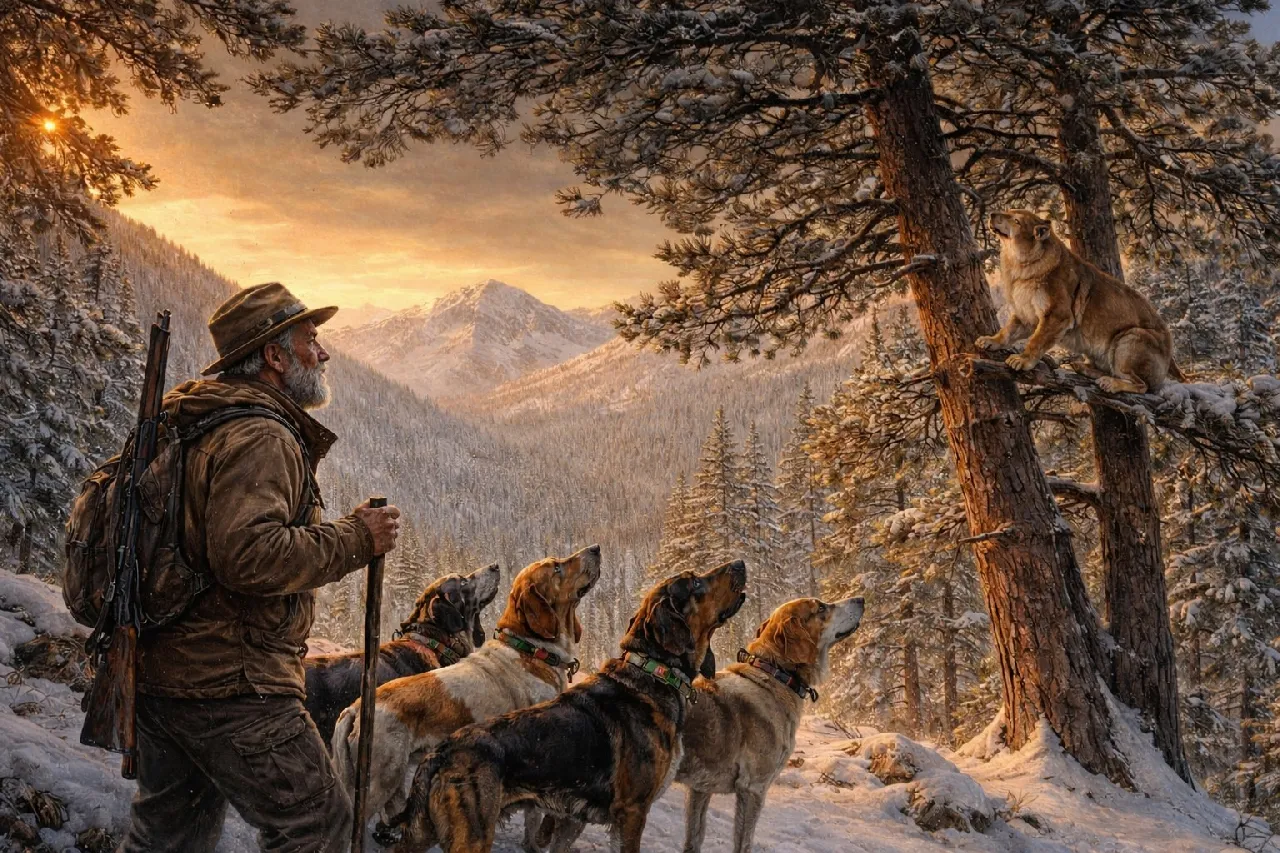
There’s a moment when you step into the clearing and see the dogs circling, front feet up on the trunk, chopping steady. Then you look up.
Every time, no matter how many decades pass, it humbles me.
A mountain lion in a tree is all muscle and quiet intensity. Long tail hanging. Eyes watching every movement below. He’s not panicked the way folks think. He’s measuring. Deciding. If you’ve hunted long enough, you understand you’re looking at something built perfect for this country.
I’ve turned loose more lions than I’ve taken. That surprises some people. But hunting with hounds gives you a choice. You can look him over. Tell if it’s a tom or a female. See if she’s heavy with kittens. Decide whether the story ends here or carries on another winter. That’s something I’ve always respected about lion hunting with dogs. It isn’t blind.
The dogs don’t care about the politics of it. They care about the work.
A good lion dog isn’t just nose and grit. He’s got to have sense. Lions will bay up on a ledge and rake a careless hound open in a heartbeat. I’ve stitched more than one shoulder by lantern light. The best dogs learn how to pressure without crowding. They tree hard but keep their feet. There’s intelligence in that, and courage too.
I’ve buried some fine hounds in my time. That’s the part no one writes about much. Little cedar crosses on a ridge. Names carved with a pocketknife. When you’ve hunted as long as I have, the dogs become chapters in your life. You remember them by voice. By the way they handled a drift. By how they looked back at you before loading into the box.
Technology’s changed plenty. We used to run beep-beep telemetry and hope you could get high enough to catch a signal. Now I can look at a handheld and see every dog moving across the map. It’s safer, no doubt. But I still trust my ears more than a screen. A locate bawl rolling into a steady chop tells me more than any satellite ever will.
People ask why I still do it.
Truth is, it isn’t about killing lions. It’s about mornings like this — breath hanging in the air, dogs working a line written hours before you ever arrived. It’s about reading country the way my father taught me. About standing in timber older than any of us and knowing your hounds just unraveled one of the finest predators God ever made.
There are days we don’t strike a track. Days the snow’s too old or the wind’s scoured the ridges clean. On those days, I still feel right being out there. Riding slow roads at daylight. Letting the dogs stretch their legs. Listening to them breathe.
Time’s caught up with my knees and my back, but it hasn’t dulled the sound of a cold-nosed hound opening on a lion track at first light. That sound still straightens me up.
One of these winters, I know I’ll follow the race only partway. Maybe sit on a ridge and listen while younger legs do the climbing. And that’ll be alright. Because lion hunting with hounds isn’t just a sport. It’s a passing down.
The dogs teach you patience. The lions teach you humility. The mountains teach you scale.
And if you’re lucky — if you stay at it long enough — you learn that the real art isn’t just in trailing a lion at daybreak.
It’s in knowing when to stand still, tip your hat to the cat in the tree, and call the dogs off into the quiet morning.
There’s a particular kind of quiet before sunrise in lion country. The timber holds its breath. The snow carries every sound, and every mistake. I’ve cut tracks in a lot of places over the years — rimrock country, cedar breaks, high mountain basins — but the feeling’s always the same when you step out of the truck and let the cold air settle in your lungs. You’re not looking for a lion yet. You’re looking for a story written in snow.
A good lion track will stop you mid-step. Big round pad. No claw marks. Tail drag sometimes faint behind it. If it’s sharp-edged and powder still laying in the bottom, you know he came through after the storm. That’s when your pulse picks up, even if you’ve been doing this for fifty years. I’ve seen young hunters get loud and excited at that moment. I just kneel down slower than I used to and lay my glove beside the print. Measure it. Think about where he’s headed. Lions travel with purpose. They use country smarter than any animal I know.
The dogs know before I say a word.
I’ve hunted with a lot of hounds — Walkers with big ringing mouths, gritty Plotts that would crawl into a brush pile after a bobcat if you let them, old crosses that didn’t look like much but could cold trail a lion that passed in the night. A true strike dog doesn’t explode on a track. He eases into it. Head low, tail working, letting that cold scent roll across his brain like smoke. When he opens — that long bawl that hangs in the canyon — it’s not noise. It’s certainty.
There’s an art to cold trailing a lion, and most of it belongs to the dogs. Lions don’t run straight like a scared deer. They sidehill. They circle. They’ll drop into rimrock and walk ledges a hound has to figure out one step at a time. A bad dog will overrun a track and lose his mind. A good one will check himself, swing wide, and pick it back up like nothing happened.
I’ve watched young hounds learn that lesson the hard way.
When the race finally warms up, you can hear it change. The bawls sharpen. The pack tightens. What started as scattered voices drifting across a canyon turns into a rolling wave of sound climbing the mountain. That’s when an old man starts walking, steady and slow, because you know they’re pushing him now.
A lion doesn’t want to fight unless he has to. Given room, he’ll climb. I’ve had races last ten minutes and I’ve had them last all day, dogs drifting out of hearing and then swinging back into range like ghosts in the timber. The country decides more than we do. Deep snow helps the hounds. Bare ground favors the cat.
I don’t run to a tree anymore. I climb deliberate, leaning on a stick cut from whatever’s handy. The younger fellows sometimes get there first, breathing hard, eyes wide. But I’ve learned something time gives a man — the tree will still be there when you arrive.
There’s a moment when you step into the clearing and see the dogs circling, front feet up on the trunk, chopping steady. Then you look up.
Every time, no matter how many decades pass, it humbles me.
A mountain lion in a tree is all muscle and quiet intensity. Long tail hanging. Eyes watching every movement below. He’s not panicked the way folks think. He’s measuring. Deciding. If you’ve hunted long enough, you understand you’re looking at something built perfect for this country.
I’ve turned loose more lions than I’ve taken. That surprises some people. But hunting with hounds gives you a choice. You can look him over. Tell if it’s a tom or a female. See if she’s heavy with kittens. Decide whether the story ends here or carries on another winter. That’s something I’ve always respected about lion hunting with dogs. It isn’t blind.
The dogs don’t care about the politics of it. They care about the work.
A good lion dog isn’t just nose and grit. He’s got to have sense. Lions will bay up on a ledge and rake a careless hound open in a heartbeat. I’ve stitched more than one shoulder by lantern light. The best dogs learn how to pressure without crowding. They tree hard but keep their feet. There’s intelligence in that, and courage too.
I’ve buried some fine hounds in my time. That’s the part no one writes about much. Little cedar crosses on a ridge. Names carved with a pocketknife. When you’ve hunted as long as I have, the dogs become chapters in your life. You remember them by voice. By the way they handled a drift. By how they looked back at you before loading into the box.
Technology’s changed plenty. We used to run beep-beep telemetry and hope you could get high enough to catch a signal. Now I can look at a handheld and see every dog moving across the map. It’s safer, no doubt. But I still trust my ears more than a screen. A locate bawl rolling into a steady chop tells me more than any satellite ever will.
People ask why I still do it.
Truth is, it isn’t about killing lions. It’s about mornings like this — breath hanging in the air, dogs working a line written hours before you ever arrived. It’s about reading country the way my father taught me. About standing in timber older than any of us and knowing your hounds just unraveled one of the finest predators God ever made.
There are days we don’t strike a track. Days the snow’s too old or the wind’s scoured the ridges clean. On those days, I still feel right being out there. Riding slow roads at daylight. Letting the dogs stretch their legs. Listening to them breathe.
Time’s caught up with my knees and my back, but it hasn’t dulled the sound of a cold-nosed hound opening on a lion track at first light. That sound still straightens me up.
One of these winters, I know I’ll follow the race only partway. Maybe sit on a ridge and listen while younger legs do the climbing. And that’ll be alright. Because lion hunting with hounds isn’t just a sport. It’s a passing down.
The dogs teach you patience. The lions teach you humility. The mountains teach you scale.
And if you’re lucky — if you stay at it long enough — you learn that the real art isn’t just in trailing a lion at daybreak.
It’s in knowing when to stand still, tip your hat to the cat in the tree, and call the dogs off into the quiet morning.




View all 0 comments