The Circle of the Rabbit
Why They Run the Way They Do
Jeff Davis | https://hounddogcentral.com
 0
0 0
0 0
0 0
0 0
0
Anyone who has spent time behind a pack of good beagles knows there’s a certain rhythm to a rabbit race. The dogs open up, the chase rolls through the briars, and sooner or later the track bends back toward where it all began. Old hunters have talked about it for generations—*rabbits run in circles.* It’s not just campfire talk either. There are real reasons behind it, and once you understand why rabbits circle, you begin to see the woods differently when the dogs strike a track.
A rabbit’s first instinct is not to run far. It’s to survive.
Unlike deer or coyotes that may bolt across miles of country, cottontail rabbits depend on a strategy built around **familiar territory**. Every rabbit has a small home range—often just a few acres of thick cover it knows intimately. Inside that little world are escape holes, brush piles, blowdowns, and tangles of briars that offer protection from predators. When danger approaches, the rabbit doesn’t aimlessly flee. Instead, it runs a looping path that keeps it inside ground it understands.
That’s the beginning of the circle.
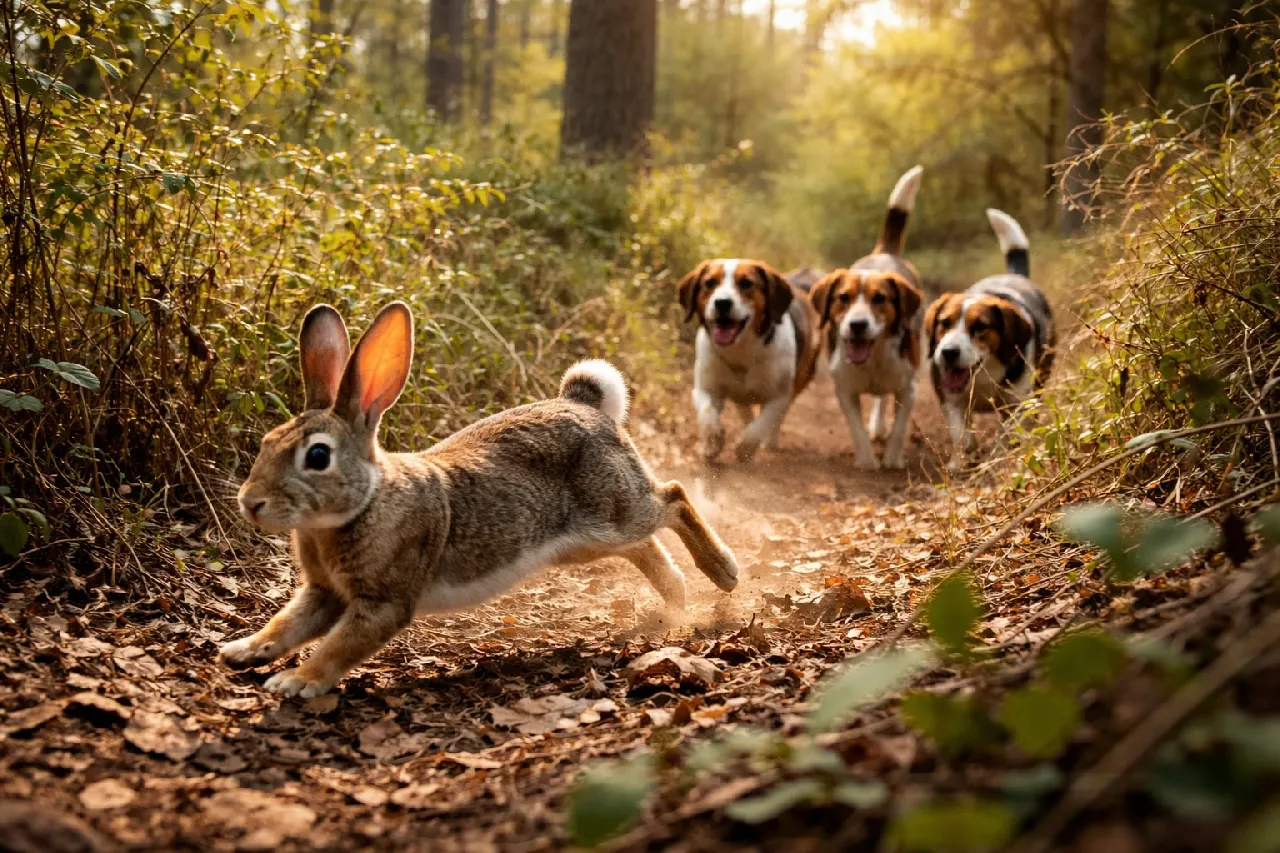
When a rabbit jumps from its bed—often in a clump of grass, under a cedar tree, or tucked inside a briar patch—it usually takes off in a hard sprint to create distance. For the first few hundred yards the rabbit may run straight, weaving through cover and trying to put obstacles between itself and whatever is chasing it. But before long, instinct pulls it back toward familiar ground.
This is where experienced rabbit hunters start smiling.
A good beagle race begins to form a **large looping circle**, sometimes a couple hundred yards wide, sometimes half a mile depending on terrain and pressure. The rabbit isn’t trying to outrun the dogs forever. Instead, it’s relying on the safety of known hiding places. By circling, the rabbit keeps passing through areas where it knows there are holes, brush piles, and escape routes if the chase gets too close.
In other words, the rabbit is running home, even while it’s running away.
Terrain plays a big role in how the circle shapes itself. In thick southern briar patches or cutover timber, circles tend to be tight and quick. In more open hardwood ridges or farm country, the loops can stretch wide as the rabbit uses fencerows, creek bottoms, and hedgerows to guide its path. A strong rabbit with good legs may run several different circles, each one slightly larger than the last as the race develops.
This behavior is exactly why rabbit hunters “post up.”
Old-timers know that if the dogs are running well and the rabbit hasn’t been lost, there’s a good chance it will come back through the same spot. Hunters spread out along likely crossings—old logging roads, field edges, or gaps in fences—and wait for the circle to close. Sometimes it takes ten minutes. Sometimes longer. But many times that rabbit slips quietly back through the same trail it used earlier, trying to return to its original hiding place.
And when the dogs are close behind, that’s when things get exciting.
Rabbits also use several tricks while running their circles. They’ll double back on their own tracks, make sharp turns, or slip through tight cover where dogs struggle to follow. Occasionally a rabbit will pause, crouching silently while the dogs overshoot the line. But even with all those tricks, the circle instinct usually brings the race back around eventually.
It’s a survival pattern shaped by thousands of years of predator pressure.
Foxes, coyotes, hawks, owls, and countless other hunters have chased rabbits long before the first beagle ever opened on a track. Circling allows rabbits to stay close to cover and avoid exposing themselves in the open for too long. It also increases their chances of reaching a bolt hole or brush pile they’ve used before.
Nature designed them to fight the chase with familiarity rather than speed alone.
For hunters and beaglers, understanding this behavior changes how you read a race. When the dogs swing wide, you can picture the arc of that circle forming through the woods. When the pack drifts toward the direction of the jump, you know the rabbit is probably closing the loop. And when the dogs suddenly get louder and tighter in their running, there’s a good chance the rabbit has turned back toward the starting point.
The circle is tightening.
It’s one of the reasons rabbit hunting has such a loyal following. A good rabbit race isn’t just noise in the briars—it’s a living puzzle unfolding across the landscape. The rabbit knows the ground. The dogs know the scent. And the hunters try to read both.
When it all comes together, you can stand quietly in the woods and feel the race moving toward you long before you see anything. The beagles’ voices grow stronger. The track straightens out. Somewhere ahead of them, slipping through the brush with long ears laid back, the rabbit is following the same instinct it always has.
It’s heading home.
And more often than not, that home lies somewhere along the circle.
A rabbit’s first instinct is not to run far. It’s to survive.
Unlike deer or coyotes that may bolt across miles of country, cottontail rabbits depend on a strategy built around **familiar territory**. Every rabbit has a small home range—often just a few acres of thick cover it knows intimately. Inside that little world are escape holes, brush piles, blowdowns, and tangles of briars that offer protection from predators. When danger approaches, the rabbit doesn’t aimlessly flee. Instead, it runs a looping path that keeps it inside ground it understands.
That’s the beginning of the circle.
When a rabbit jumps from its bed—often in a clump of grass, under a cedar tree, or tucked inside a briar patch—it usually takes off in a hard sprint to create distance. For the first few hundred yards the rabbit may run straight, weaving through cover and trying to put obstacles between itself and whatever is chasing it. But before long, instinct pulls it back toward familiar ground.
This is where experienced rabbit hunters start smiling.
A good beagle race begins to form a **large looping circle**, sometimes a couple hundred yards wide, sometimes half a mile depending on terrain and pressure. The rabbit isn’t trying to outrun the dogs forever. Instead, it’s relying on the safety of known hiding places. By circling, the rabbit keeps passing through areas where it knows there are holes, brush piles, and escape routes if the chase gets too close.
In other words, the rabbit is running home, even while it’s running away.
Terrain plays a big role in how the circle shapes itself. In thick southern briar patches or cutover timber, circles tend to be tight and quick. In more open hardwood ridges or farm country, the loops can stretch wide as the rabbit uses fencerows, creek bottoms, and hedgerows to guide its path. A strong rabbit with good legs may run several different circles, each one slightly larger than the last as the race develops.
This behavior is exactly why rabbit hunters “post up.”
Old-timers know that if the dogs are running well and the rabbit hasn’t been lost, there’s a good chance it will come back through the same spot. Hunters spread out along likely crossings—old logging roads, field edges, or gaps in fences—and wait for the circle to close. Sometimes it takes ten minutes. Sometimes longer. But many times that rabbit slips quietly back through the same trail it used earlier, trying to return to its original hiding place.
And when the dogs are close behind, that’s when things get exciting.
Rabbits also use several tricks while running their circles. They’ll double back on their own tracks, make sharp turns, or slip through tight cover where dogs struggle to follow. Occasionally a rabbit will pause, crouching silently while the dogs overshoot the line. But even with all those tricks, the circle instinct usually brings the race back around eventually.
It’s a survival pattern shaped by thousands of years of predator pressure.
Foxes, coyotes, hawks, owls, and countless other hunters have chased rabbits long before the first beagle ever opened on a track. Circling allows rabbits to stay close to cover and avoid exposing themselves in the open for too long. It also increases their chances of reaching a bolt hole or brush pile they’ve used before.
Nature designed them to fight the chase with familiarity rather than speed alone.
For hunters and beaglers, understanding this behavior changes how you read a race. When the dogs swing wide, you can picture the arc of that circle forming through the woods. When the pack drifts toward the direction of the jump, you know the rabbit is probably closing the loop. And when the dogs suddenly get louder and tighter in their running, there’s a good chance the rabbit has turned back toward the starting point.
The circle is tightening.
It’s one of the reasons rabbit hunting has such a loyal following. A good rabbit race isn’t just noise in the briars—it’s a living puzzle unfolding across the landscape. The rabbit knows the ground. The dogs know the scent. And the hunters try to read both.
When it all comes together, you can stand quietly in the woods and feel the race moving toward you long before you see anything. The beagles’ voices grow stronger. The track straightens out. Somewhere ahead of them, slipping through the brush with long ears laid back, the rabbit is following the same instinct it always has.
It’s heading home.
And more often than not, that home lies somewhere along the circle.




View all 0 comments