What Is a Competition Nite Hunt?
A judge’s perspective from behind the card
Jeff Davis | https://hounddogcentral.com
 0
0 0
0 0
0 0
0 0
0
If you’ve ever stood on the edge of a dark timberline and listened to a good hound strike a track, you already understand the heart of this sport. A competition nite hunt simply puts structure, rules, and a scorecard around that same experience. It’s still about coonhounds doing what they were bred to do—but now we’re measuring how well they do it.
I’ve judged more casts than I can count, and I’ll tell you this right up front: a nite hunt isn’t about who owns the fanciest dog. It’s about accuracy, honesty, and consistency under pressure—both from the dogs and the handlers.
Let’s walk through it like you’re stepping out of the clubhouse with me.
A competition nite hunt is typically hosted by a local coonhound club under a registry like UKC or PKC. Hunters enter their dogs, casts are drawn, and groups of usually three to four handlers head into the woods with a judge. Each cast operates independently. You’re not hunting against everyone at the event—you’re hunting against the other dogs in your cast. At the end of the night, cast winners are compared to determine the overall winner. Simple on paper. Different story in the woods.
Before anything else, names get called, casts get assigned, and a judge is either appointed or selected from within the cast. You’ll hear folks talking, sizing each other up a little. That’s normal. Once you leave the clubhouse, everything changes. It gets quiet. Focused. From that point forward, the judge carries the scorecard—and what’s written on that card matters.
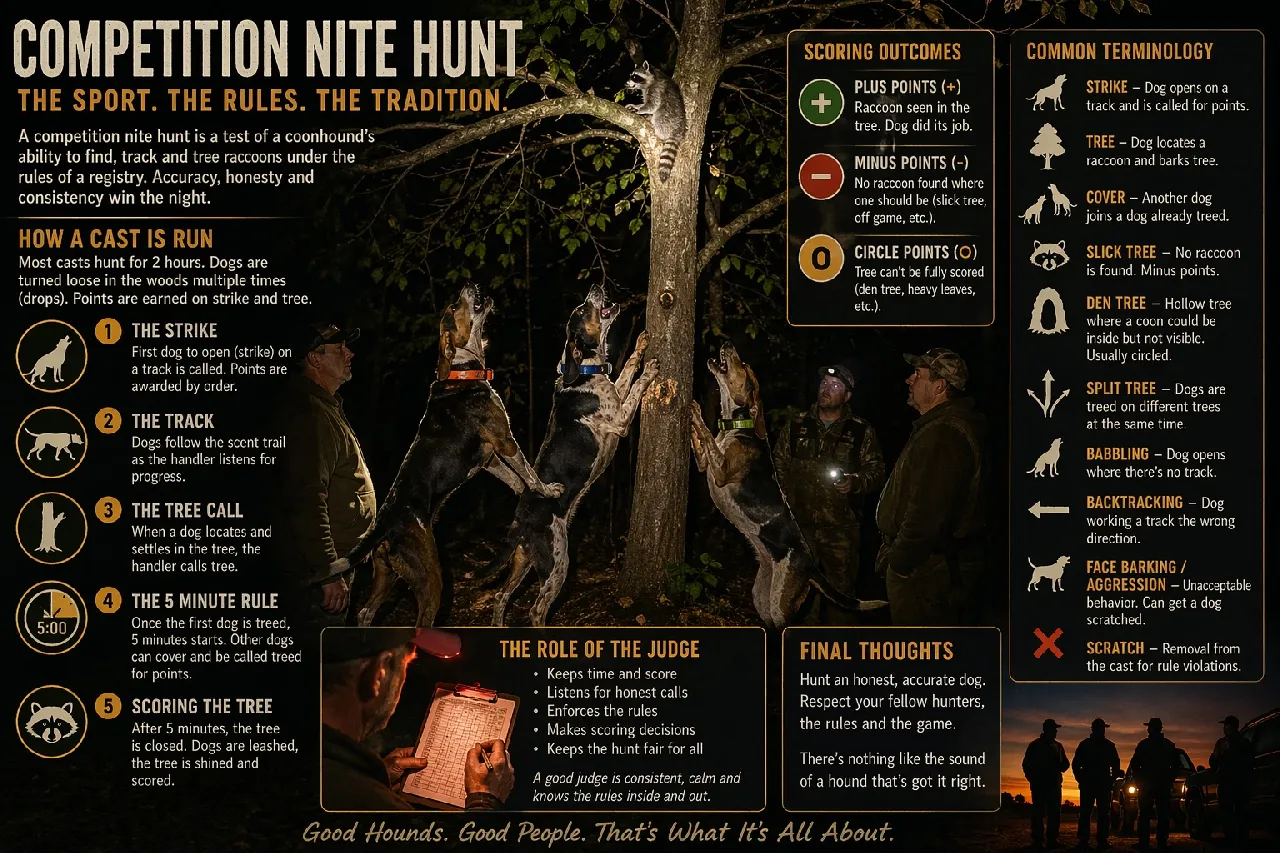
A hunt usually runs for a set time—commonly 2 hours. During that time, handlers will turn dogs loose multiple times (called drops). Each drop is an opportunity for dogs to strike a track and tree a raccoon.
Here’s how it unfolds.
1. The Strike - Dogs are released. They disappear into the dark. Sooner or later, one opens—gives mouth on a track.
A handler will call: “Strike my dog.”
That call locks in strike points based on position:
* First dog struck = highest points
* Second, third, fourth = descending points
From a judge’s standpoint, I’m listening for honesty. If your dog hasn’t opened, don’t call it. Calling early might gain points—but it’ll cost you later if you’re wrong.
2. The Track - Now the dogs are working a scent trail. You’ll hear changes in their voices—long bawls, quick chops, drifting, locating. Good handlers know their dog’s voice like family. This is where experience shows. Some dogs move a track fast and clean. Others struggle, check, and circle.The judge isn’t scoring style here—we’re watching for progress and listening for consistency.
3. The Tree Call - Eventually, a dog locates and settles in. That distinct change in bark—sharp, steady, rhythmic—that’s what we call treeing.
Handler calls:
“Tree my dog.”
Tree points are awarded the same way as strike—first gets the most. Now the pressure ramps up. Because this is where hunts are won and lost.
4. The Five-Minute Rule - Once the first dog is declared treed, a five-minute clock starts. Other dogs have that time to cover (join the tree) and be called treed for available points. After five minutes, the tree is considered closed. No more dogs can earn full tree points there.
5. Scoring the Tree - Once the cast arrives, the judge takes over. We leash the dogs. Shine the tree. Look for the raccoon. This is where accuracy matters more than anything.
There are three possible outcomes:
Plus Points (+): You see the coon. Dog did its job.
Minus Points (-): No coon found where one should be (slick tree, off game, etc.).
Circle Points (○): Tree can’t be fully scored (den tree, heavy leaves, etc.).
A dog that trees a lot but doesn’t have the coon won’t win consistently. I’ve seen flashy tree dogs get beat by quiet, accurate hounds more times than I can count.
If you’re new, the language can feel like another world. Here’s a judge’s quick translation guide.
Strike - When a dog opens on a track and is called for points.
Tree - When a dog locates and commits to a tree.
Cover - When another dog joins a dog already treed.
Slick Tree - A tree where no raccoon is found. That’s minus points.
Den Tree - A hollow tree where a coon could be inside but not visible. Usually circled.
Split Tree - When dogs are treed on different trees at the same time. Now things get interesting—and complicated.
Babbling - A dog opening where there’s no real track. Judges watch this closely.
Backtracking - Dog working a track the wrong direction.
Face Barking / Aggression - Unacceptable behavior. Can get a dog scratched.
Scratch - Removal from the cast for rule violations.
Let me be clear: the judge isn’t there to win. He’s there to keep it fair. I’m watching the dogs, listening to calls, keeping time, and making scoring decisions. Sometimes those decisions aren’t popular. That’s part of it. A good judge is consistent, calm, and knows the rules inside and out. A great judge doesn’t get rattled when things get tense—and they will.
You’ll hear people talk strategy like it’s a chess match. Truth is, the best strategy is simple: Hunt an honest, accurate dog. Everything else—when to call, when to hold back, when to take a chance—that comes with experience. Some nights you’ll get beat by a better dog. Some nights you’ll beat yourself.
A competition nite hunt isn’t just about winning. It’s about testing your dog. It’s about learning. It’s about standing in the dark with a group of folks who all understand what a good hound sounds like rolling through the woods.
You’ll make mistakes early. Everyone does. Call your dog honestly. Listen more than you talk. Pay attention to how casts are run. And above all—respect the game.
Because when that hound rolls over into a steady chop and you know he’s got it right… there’s nothing else quite like it.
I’ve judged more casts than I can count, and I’ll tell you this right up front: a nite hunt isn’t about who owns the fanciest dog. It’s about accuracy, honesty, and consistency under pressure—both from the dogs and the handlers.
Let’s walk through it like you’re stepping out of the clubhouse with me.
The Basics: What You’re Walking Into
A competition nite hunt is typically hosted by a local coonhound club under a registry like UKC or PKC. Hunters enter their dogs, casts are drawn, and groups of usually three to four handlers head into the woods with a judge. Each cast operates independently. You’re not hunting against everyone at the event—you’re hunting against the other dogs in your cast. At the end of the night, cast winners are compared to determine the overall winner. Simple on paper. Different story in the woods.
Drawing Out and Heading to the Woods
Before anything else, names get called, casts get assigned, and a judge is either appointed or selected from within the cast. You’ll hear folks talking, sizing each other up a little. That’s normal. Once you leave the clubhouse, everything changes. It gets quiet. Focused. From that point forward, the judge carries the scorecard—and what’s written on that card matters.
How a Cast Is Run
A hunt usually runs for a set time—commonly 2 hours. During that time, handlers will turn dogs loose multiple times (called drops). Each drop is an opportunity for dogs to strike a track and tree a raccoon.
Here’s how it unfolds.
1. The Strike - Dogs are released. They disappear into the dark. Sooner or later, one opens—gives mouth on a track.
A handler will call: “Strike my dog.”
That call locks in strike points based on position:
* First dog struck = highest points
* Second, third, fourth = descending points
From a judge’s standpoint, I’m listening for honesty. If your dog hasn’t opened, don’t call it. Calling early might gain points—but it’ll cost you later if you’re wrong.
2. The Track - Now the dogs are working a scent trail. You’ll hear changes in their voices—long bawls, quick chops, drifting, locating. Good handlers know their dog’s voice like family. This is where experience shows. Some dogs move a track fast and clean. Others struggle, check, and circle.The judge isn’t scoring style here—we’re watching for progress and listening for consistency.
3. The Tree Call - Eventually, a dog locates and settles in. That distinct change in bark—sharp, steady, rhythmic—that’s what we call treeing.
Handler calls:
“Tree my dog.”
Tree points are awarded the same way as strike—first gets the most. Now the pressure ramps up. Because this is where hunts are won and lost.
4. The Five-Minute Rule - Once the first dog is declared treed, a five-minute clock starts. Other dogs have that time to cover (join the tree) and be called treed for available points. After five minutes, the tree is considered closed. No more dogs can earn full tree points there.
5. Scoring the Tree - Once the cast arrives, the judge takes over. We leash the dogs. Shine the tree. Look for the raccoon. This is where accuracy matters more than anything.
There are three possible outcomes:
Plus Points (+): You see the coon. Dog did its job.
Minus Points (-): No coon found where one should be (slick tree, off game, etc.).
Circle Points (○): Tree can’t be fully scored (den tree, heavy leaves, etc.).
A dog that trees a lot but doesn’t have the coon won’t win consistently. I’ve seen flashy tree dogs get beat by quiet, accurate hounds more times than I can count.
Common Terminology You’ll Hear
If you’re new, the language can feel like another world. Here’s a judge’s quick translation guide.
Strike - When a dog opens on a track and is called for points.
Tree - When a dog locates and commits to a tree.
Cover - When another dog joins a dog already treed.
Slick Tree - A tree where no raccoon is found. That’s minus points.
Den Tree - A hollow tree where a coon could be inside but not visible. Usually circled.
Split Tree - When dogs are treed on different trees at the same time. Now things get interesting—and complicated.
Babbling - A dog opening where there’s no real track. Judges watch this closely.
Backtracking - Dog working a track the wrong direction.
Face Barking / Aggression - Unacceptable behavior. Can get a dog scratched.
Scratch - Removal from the cast for rule violations.
The Role of the Judge
Let me be clear: the judge isn’t there to win. He’s there to keep it fair. I’m watching the dogs, listening to calls, keeping time, and making scoring decisions. Sometimes those decisions aren’t popular. That’s part of it. A good judge is consistent, calm, and knows the rules inside and out. A great judge doesn’t get rattled when things get tense—and they will.
Strategy (Without Overthinking It)
You’ll hear people talk strategy like it’s a chess match. Truth is, the best strategy is simple: Hunt an honest, accurate dog. Everything else—when to call, when to hold back, when to take a chance—that comes with experience. Some nights you’ll get beat by a better dog. Some nights you’ll beat yourself.
Final Thoughts from the Tailgate
A competition nite hunt isn’t just about winning. It’s about testing your dog. It’s about learning. It’s about standing in the dark with a group of folks who all understand what a good hound sounds like rolling through the woods.
You’ll make mistakes early. Everyone does. Call your dog honestly. Listen more than you talk. Pay attention to how casts are run. And above all—respect the game.
Because when that hound rolls over into a steady chop and you know he’s got it right… there’s nothing else quite like it.



View all 0 comments