
Scenthound vs Sighthound Explained
How These Hounds Hunt, Think, and Live
Jeff Davis | https://hounddogcentral.com
 0
0 0
0 0
0 0
0 0
0
Folks new to hounds often lump them all into one basket, but anyone who has followed a dog through briars at daylight or watched one lock onto game across an open stretch knows better. The difference between a scenthound and a sighthound is not some fancy kennel-club technicality. It shows up in the way the dog moves, the way it thinks, and the way it hunts when the conditions turn honest. If you are trying to understand which kind of hound suits your home, your hunting interests, or simply your admiration for these old working breeds, it helps to see them for what they were made to do.
At the most basic level, scenthounds hunt with their nose and sighthounds hunt with their eyes. That sounds simple enough, but the deeper truth is that each type was shaped by generations of practical work. One dog was built to sort out drifting scent over ground and time. The other was made to spot movement fast and close the distance in a hurry. Those differences affect everything from training and recall to exercise needs and how they act in the yard.
Scenthound vs Sighthound: The Core Difference
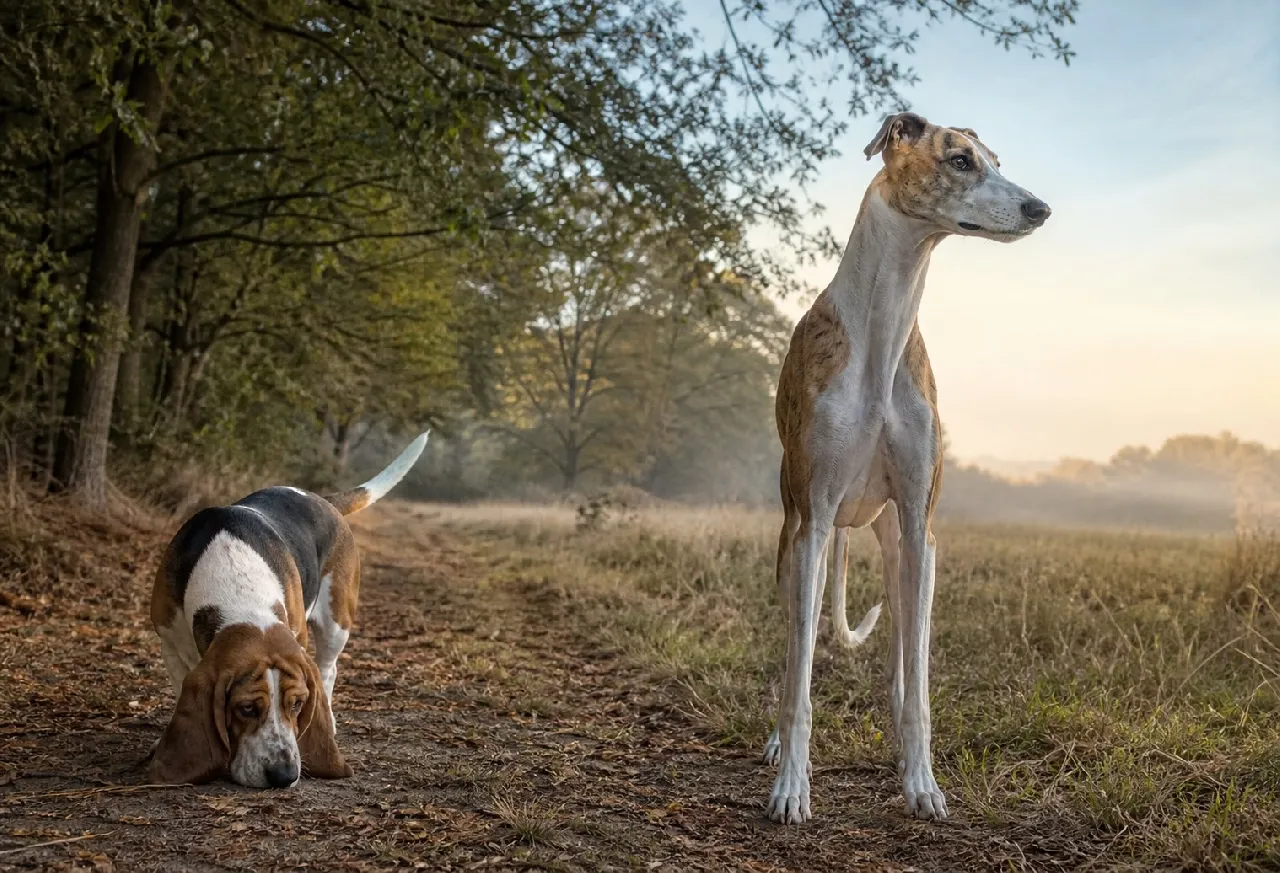
A scenthound is a dog bred to follow odor. When a scenthound drops its head and takes a line, the world narrows to that scent picture. You see this in breeds like the Beagle, Bloodhound, Coonhound, Basset Hound, and American Foxhound. These dogs were designed to work trails that may be fresh, fading, tangled, or hours old. They trust their nose above all else, and most of them will keep working long after another dog would have quit.
A sighthound is a dog bred to locate prey by sight and pursue it with speed. Greyhounds, Whippets, Salukis, Borzois, Afghan Hounds, and Irish Wolfhounds all fall into this group. They are visual hunters, built to detect motion, explode into action, and run down game in open country. Where a scenthound might puzzle over a line in a patch of timber, a sighthound shines when there is room to see and room to run.
That distinction may sound clean on paper, but in the field it feels even sharper. A scenthound hunts with patience and persistence. A sighthound hunts with timing, athleticism, and a burst of commitment that is over almost as quickly as it begins.
How Scenthounds Hunt in the Real World
Spend enough mornings with scenthounds and you come to respect just how much information lives in the ground. A good nose can tell a dog what crossed there, how long ago it moved, where it turned, and whether the trail is worth pressing. Scenthounds work methodically, often with their head low, drawing in scent from the ground and air, sorting old from new. They are problem-solvers, and many are willing to work independently without much guidance from the handler.
That is why scenthounds have long been favored for trailing, rabbit hunting, raccoon hunting, and tracking wounded game. In rough cover, thick woods, wet bottoms, and places where visibility is poor, the nose wins. I have watched a scenthound stay honest on a cold trail when a man would swear there was nothing there at all. Then, little by little, the line warms, the dog gains confidence, and the hunt comes alive.
Traits That Set Scenthounds Apart
Most scenthounds have long ears, loose skin around the face, and a solid, practical build. Those features were not just bred for looks. Their body structure supports the kind of close, sustained trailing they do. Temperament-wise, many are steady, social, and determined, but also famously stubborn when a scent is more interesting than you are. That is not disobedience in the human sense. It is focus bred so deep that it can be hard to interrupt.
Owners often find scenthounds affectionate at home and relentless outdoors. They may bay, bawl, or use a strong voice on trail, which some folks love and some neighbors do not. If you want a dog that lives for nose work, tracking games, and long, thoughtful searches, a scenthound offers something special.
How Sighthounds Hunt in the Real World
Sighthounds are a different kind of marvel. They are built like drawn bows: deep chest, tucked waist, long legs, flexible spine, and muscle meant for rapid acceleration. When prey breaks into view, the response is immediate. A good sighthound does not need to work out a scent problem over distance. It reads motion, judges speed, and gives chase with startling intensity.
These dogs developed in country where open land made visual hunting practical. Their game was often seen first and pursued second. In that setting, speed and agility mattered more than a cold nose. Watching a sighthound run is seeing purpose turned into motion. There is little wasted effort. One moment the dog is still as a fence post, and the next it is covering ground so cleanly it hardly seems to touch it.
Traits That Set Sighthounds Apart
Sighthounds tend to be quiet, sensitive, and somewhat reserved compared to many scenthounds. Around the house, they are often calmer than people expect. Outdoors, though, that prey drive can switch on in a heartbeat. Their attention is easily captured by movement, whether that is a squirrel, rabbit, deer, or even a blowing bag in the wrong moment.
Because they were bred for explosive pursuit rather than prolonged searching, their exercise style is often different. Many do well with steady walks and chances for short, safe sprints. They are not always the endless-mile dog that some working scenthounds can be, but they need room, security, and management when their chase instinct kicks in.
Training Differences Between Scenthounds and Sighthounds
This is where many owners get surprised. Neither type is dull, but they can be independent in very different ways. A scenthound may hear you perfectly well and decide the scent it is sorting deserves priority. A sighthound may be responsive one second and then mentally gone the next if something flashes across its field of view.
Training a scenthound usually means working with the dog's nose, not against it. Scent games, tracking exercises, and reward-based repetition go farther than trying to drill absolute robotic obedience. Recall can be a challenge because the dog was bred to commit to a trail. Patience matters. Consistency matters more.
With sighthounds, training often hinges on trust, calm repetition, and safe management. Many are softer in temperament than people realize and do not thrive under heavy-handed handling. Recall can also be difficult, especially in open spaces where something moving can trigger pursuit. A fenced area and leash discipline are often non-negotiable for safety.
In both cases, the old mistake is expecting a hound to behave like a breed developed to constantly check in with people. Hounds were made to think and act with a degree of independence. If you respect that, training becomes more productive and a lot less frustrating.
Which Type of Hound Is Better for Family Life?
That depends on the household. Many scenthounds make cheerful, affectionate family dogs, especially if their need for activity and scent-based enrichment is met. They often enjoy companionship and can do well in homes that appreciate their vocal nature and occasional stubborn streak. A bored scenthound, though, can turn into a roaming, howling, trash-investigating project in a hurry.
Sighthounds often surprise people by being excellent house dogs. Many are gentle, clean, and happy to lounge once their exercise needs are met. They can be wonderful for quieter homes. Still, owners must understand prey drive. Small pets, unsecured yards, and off-leash freedom in open areas can create real problems if not handled wisely.
If you live in a neighborhood and want a calmer indoor dog, some sighthounds fit that mold beautifully. If you love scent work, outdoor adventure, and a dog that engages the world nose-first, a scenthound may feel like the more natural companion.
Choosing Between a Scenthound and a Sighthound
The best choice comes down to what you value most. If you admire tracking ability, persistence, voice, and that old-school hunting-dog grit, lean toward a scenthound. If you appreciate elegance, speed, quiet presence, and a dog that can go from couch rest to full pursuit in an instant, a sighthound may suit you better.
It also helps to be honest about your land, fencing, and daily routine. A scenthound in a lightly managed yard may follow its nose right out of your plans. A sighthound with a weak fence may spot a target and clear distance before you have taken two steps. Both need owners who understand instinct and work with it instead of pretending it is not there.
The finest hounds I have known were not good because they fit a trend or looked handsome in a photo. They were good because their owners understood what kind of dog stood at the other end of the lead. That is the heart of this whole conversation. Scenthounds and sighthounds are both hounds, but they were shaped for different jobs, and they carry those jobs in their bones.
Final Thoughts on Scenthound vs Sighthound
So when someone asks, "What is the difference between a scenthound and a sighthound?" the plain answer is this: one follows scent, the other follows sight. But the fuller answer is that each type brings its own style of intelligence, drive, beauty, and challenge. A scenthound reads the invisible trail left behind. A sighthound reads the living motion ahead. One hunts with endurance and nose. The other hunts with speed and eye.
For dog owners interested in hound dogs, learning that distinction is more than trivia. It is the first step toward choosing a dog you can actually live with and appreciate for what it is. When you understand how a hound was made to work, you stop fighting its nature and start seeing the brilliance in it. That is when owning a hound gets truly rewarding.
At the most basic level, scenthounds hunt with their nose and sighthounds hunt with their eyes. That sounds simple enough, but the deeper truth is that each type was shaped by generations of practical work. One dog was built to sort out drifting scent over ground and time. The other was made to spot movement fast and close the distance in a hurry. Those differences affect everything from training and recall to exercise needs and how they act in the yard.
Scenthound vs Sighthound: The Core Difference
A scenthound is a dog bred to follow odor. When a scenthound drops its head and takes a line, the world narrows to that scent picture. You see this in breeds like the Beagle, Bloodhound, Coonhound, Basset Hound, and American Foxhound. These dogs were designed to work trails that may be fresh, fading, tangled, or hours old. They trust their nose above all else, and most of them will keep working long after another dog would have quit.
A sighthound is a dog bred to locate prey by sight and pursue it with speed. Greyhounds, Whippets, Salukis, Borzois, Afghan Hounds, and Irish Wolfhounds all fall into this group. They are visual hunters, built to detect motion, explode into action, and run down game in open country. Where a scenthound might puzzle over a line in a patch of timber, a sighthound shines when there is room to see and room to run.
That distinction may sound clean on paper, but in the field it feels even sharper. A scenthound hunts with patience and persistence. A sighthound hunts with timing, athleticism, and a burst of commitment that is over almost as quickly as it begins.
How Scenthounds Hunt in the Real World
Spend enough mornings with scenthounds and you come to respect just how much information lives in the ground. A good nose can tell a dog what crossed there, how long ago it moved, where it turned, and whether the trail is worth pressing. Scenthounds work methodically, often with their head low, drawing in scent from the ground and air, sorting old from new. They are problem-solvers, and many are willing to work independently without much guidance from the handler.
That is why scenthounds have long been favored for trailing, rabbit hunting, raccoon hunting, and tracking wounded game. In rough cover, thick woods, wet bottoms, and places where visibility is poor, the nose wins. I have watched a scenthound stay honest on a cold trail when a man would swear there was nothing there at all. Then, little by little, the line warms, the dog gains confidence, and the hunt comes alive.
Traits That Set Scenthounds Apart
Most scenthounds have long ears, loose skin around the face, and a solid, practical build. Those features were not just bred for looks. Their body structure supports the kind of close, sustained trailing they do. Temperament-wise, many are steady, social, and determined, but also famously stubborn when a scent is more interesting than you are. That is not disobedience in the human sense. It is focus bred so deep that it can be hard to interrupt.
Owners often find scenthounds affectionate at home and relentless outdoors. They may bay, bawl, or use a strong voice on trail, which some folks love and some neighbors do not. If you want a dog that lives for nose work, tracking games, and long, thoughtful searches, a scenthound offers something special.
How Sighthounds Hunt in the Real World
Sighthounds are a different kind of marvel. They are built like drawn bows: deep chest, tucked waist, long legs, flexible spine, and muscle meant for rapid acceleration. When prey breaks into view, the response is immediate. A good sighthound does not need to work out a scent problem over distance. It reads motion, judges speed, and gives chase with startling intensity.
These dogs developed in country where open land made visual hunting practical. Their game was often seen first and pursued second. In that setting, speed and agility mattered more than a cold nose. Watching a sighthound run is seeing purpose turned into motion. There is little wasted effort. One moment the dog is still as a fence post, and the next it is covering ground so cleanly it hardly seems to touch it.
Traits That Set Sighthounds Apart
Sighthounds tend to be quiet, sensitive, and somewhat reserved compared to many scenthounds. Around the house, they are often calmer than people expect. Outdoors, though, that prey drive can switch on in a heartbeat. Their attention is easily captured by movement, whether that is a squirrel, rabbit, deer, or even a blowing bag in the wrong moment.
Because they were bred for explosive pursuit rather than prolonged searching, their exercise style is often different. Many do well with steady walks and chances for short, safe sprints. They are not always the endless-mile dog that some working scenthounds can be, but they need room, security, and management when their chase instinct kicks in.
Training Differences Between Scenthounds and Sighthounds
This is where many owners get surprised. Neither type is dull, but they can be independent in very different ways. A scenthound may hear you perfectly well and decide the scent it is sorting deserves priority. A sighthound may be responsive one second and then mentally gone the next if something flashes across its field of view.
Training a scenthound usually means working with the dog's nose, not against it. Scent games, tracking exercises, and reward-based repetition go farther than trying to drill absolute robotic obedience. Recall can be a challenge because the dog was bred to commit to a trail. Patience matters. Consistency matters more.
With sighthounds, training often hinges on trust, calm repetition, and safe management. Many are softer in temperament than people realize and do not thrive under heavy-handed handling. Recall can also be difficult, especially in open spaces where something moving can trigger pursuit. A fenced area and leash discipline are often non-negotiable for safety.
In both cases, the old mistake is expecting a hound to behave like a breed developed to constantly check in with people. Hounds were made to think and act with a degree of independence. If you respect that, training becomes more productive and a lot less frustrating.
Which Type of Hound Is Better for Family Life?
That depends on the household. Many scenthounds make cheerful, affectionate family dogs, especially if their need for activity and scent-based enrichment is met. They often enjoy companionship and can do well in homes that appreciate their vocal nature and occasional stubborn streak. A bored scenthound, though, can turn into a roaming, howling, trash-investigating project in a hurry.
Sighthounds often surprise people by being excellent house dogs. Many are gentle, clean, and happy to lounge once their exercise needs are met. They can be wonderful for quieter homes. Still, owners must understand prey drive. Small pets, unsecured yards, and off-leash freedom in open areas can create real problems if not handled wisely.
If you live in a neighborhood and want a calmer indoor dog, some sighthounds fit that mold beautifully. If you love scent work, outdoor adventure, and a dog that engages the world nose-first, a scenthound may feel like the more natural companion.
Choosing Between a Scenthound and a Sighthound
The best choice comes down to what you value most. If you admire tracking ability, persistence, voice, and that old-school hunting-dog grit, lean toward a scenthound. If you appreciate elegance, speed, quiet presence, and a dog that can go from couch rest to full pursuit in an instant, a sighthound may suit you better.
It also helps to be honest about your land, fencing, and daily routine. A scenthound in a lightly managed yard may follow its nose right out of your plans. A sighthound with a weak fence may spot a target and clear distance before you have taken two steps. Both need owners who understand instinct and work with it instead of pretending it is not there.
The finest hounds I have known were not good because they fit a trend or looked handsome in a photo. They were good because their owners understood what kind of dog stood at the other end of the lead. That is the heart of this whole conversation. Scenthounds and sighthounds are both hounds, but they were shaped for different jobs, and they carry those jobs in their bones.
Final Thoughts on Scenthound vs Sighthound
So when someone asks, "What is the difference between a scenthound and a sighthound?" the plain answer is this: one follows scent, the other follows sight. But the fuller answer is that each type brings its own style of intelligence, drive, beauty, and challenge. A scenthound reads the invisible trail left behind. A sighthound reads the living motion ahead. One hunts with endurance and nose. The other hunts with speed and eye.
For dog owners interested in hound dogs, learning that distinction is more than trivia. It is the first step toward choosing a dog you can actually live with and appreciate for what it is. When you understand how a hound was made to work, you stop fighting its nature and start seeing the brilliance in it. That is when owning a hound gets truly rewarding.




View all 0 comments