
Radio Telemetry Collars for Hound Hunting
How They Work, How to Use Them, and Why They Still Matter
Jeff Davis | https://hounddogcentral.com
 0
0 0
0 0
0 0
0 0
0
There’s a certain kind of confidence that comes from knowing you can still find your dogs when everything else fails. Before screens, satellites, and handheld maps, houndsmen depended on nothing more than a signal, a receiver, and their own ability to read the land. Radio telemetry collars weren’t just a tool, they were a skill set. And even today, they haven’t lost their place in the woods.
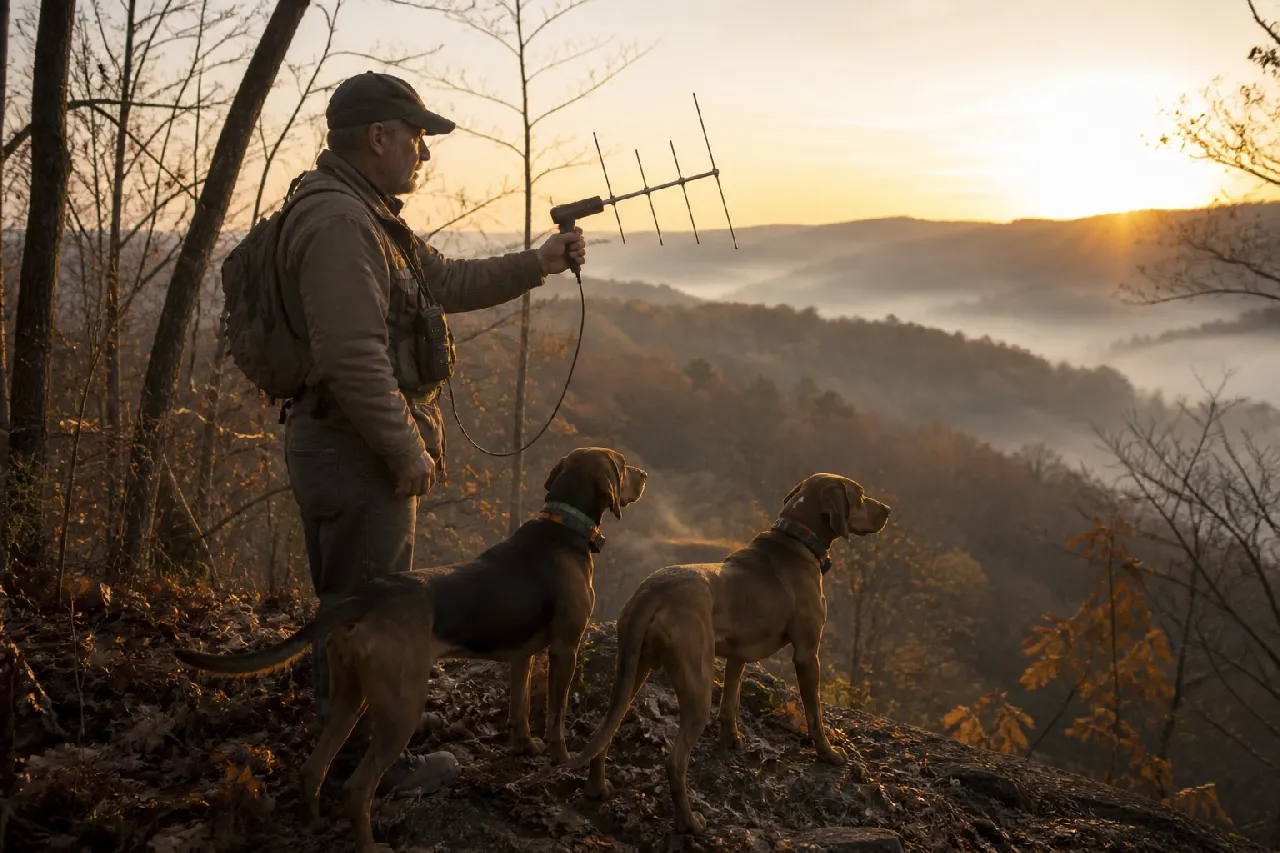
Radio telemetry tracking works on a simple principle: a collar worn by the dog emits a radio signal on a specific frequency, and a handheld receiver picks up that signal. That receiver, paired with a directional antenna—usually a Yagi antenna with multiple elements, allows the handler to determine the direction of the signal. By turning slowly in a full circle and listening for the strongest tone or watching the signal strength indicator, you can pinpoint the direction your dog is traveling or holding.
It’s not GPS. It doesn’t give you a map or a dot on a screen. What it gives you is direction ... and with experience, distance.
The history of radio tracking in hound hunting goes back several decades, with roots tied closely to wildlife research. In the 1960s and 1970s, biologists began using radio telemetry to track deer, wolves, and other game animals. It didn’t take long for houndsmen to recognize the value. By the late 1970s and into the 1980s, telemetry collars began showing up in the hands of serious hunters, especially those running big country where dogs could cover miles in a short time.
Back then, equipment was bulkier, batteries didn’t last as long, and signal clarity could be inconsistent. But it worked and more importantly, it worked where nothing else could. Over time, manufacturers refined the technology. Collars became smaller and tougher. Receivers became more sensitive. Antennas improved. What hasn’t changed is the core concept: a dependable signal that cuts through terrain where modern systems sometimes struggle.
Using a telemetry system effectively takes a bit of practice, but once you understand the basics, it becomes second nature. Each collar is assigned a unique frequency, and your receiver is tuned to match it. When you’re in the field, you’ll raise your antenna, hold it level, and slowly sweep the horizon. As the antenna aligns with the direction of the collar, the signal becomes stronger, either through an audible tone or a visual meter.
Most experienced handlers don’t just take one reading. They’ll move to a second location and take another bearing, sometimes even a third. By mentally triangulating those directions, you can narrow down the dog’s location with surprising accuracy. Terrain plays a role, of course. Hills can block signals, while ridgelines can carry them much farther than expected. Over time, you learn to interpret those quirks instead of fighting them.
There’s a rhythm to it. Stop. Listen. Turn. Think. Move. Repeat.
Compared to GPS tracking systems, telemetry might seem outdated at first glance—but that’s not the whole story. GPS collars rely on satellites and communication between the collar and handheld device, often through radio frequencies as well. When everything is working properly, GPS gives you real-time location data, mapping, speed, and even behavior indicators. It’s incredibly convenient.
But convenience comes with tradeoffs.
One of the biggest advantages of radio telemetry is reliability. It doesn’t depend on satellites, software, or firmware updates. If the collar is transmitting and the receiver has battery, you have a signal. In extremely thick cover, deep hollows, or mountainous terrain, telemetry signals can sometimes reach where GPS communication drops out. Many hunters have experienced that moment, your GPS screen goes blank, but your telemetry receiver is still picking up a steady beep.
Battery life is another strong point. Telemetry collars often run much longer on a single battery compared to GPS collars, especially older GPS units or those running continuous updates. For long hunts or multi-day trips, that can make a difference.
There’s also simplicity. Telemetry systems are straightforward. Fewer components mean fewer points of failure. You’re not dealing with software glitches or pairing issues. Turn it on, tune it in, and go to work.
But telemetry isn’t without its drawbacks.
The biggest limitation is the lack of precise location data. You’re not looking at a map, you’re interpreting a signal. That requires experience and patience, and it can take time to close the distance on a dog, especially if they’re moving. In unfamiliar terrain, or for newer handlers, that learning curve can be frustrating.
Telemetry also requires active tracking. You have to stop, take bearings, and think through your next move. GPS, by contrast, gives you constant updates without that effort. For hunters managing multiple dogs or covering large areas quickly, that difference matters.
Range can also be affected by terrain more dramatically with telemetry, depending on your position. While signals can sometimes travel surprisingly far, they can also be blocked or reflected, creating false readings or “bounce.” Learning to recognize those conditions is part of becoming proficient.
In today’s world, many houndsmen don’t see it as a choice between telemetry and GPS, they use both. GPS provides the convenience and real-time awareness, while telemetry serves as a dependable backup when conditions get tough or technology fails. It’s not uncommon to see dogs wearing dual collars for that reason alone.
And there’s something else worth mentioning, something harder to quantify.
Using telemetry keeps you engaged. It forces you to read the land, think about direction, and stay connected to what your dogs are doing instead of just watching a screen. For some, that’s not a drawback. It’s part of the experience.
Radio telemetry collars may not be the newest tool in the box, but they’ve earned their place through decades of real-world use. They’re dependable, proven, and still highly relevant, especially for hunters who value reliability over convenience and skill over automation.
In a world where technology changes fast, it’s worth remembering that sometimes the old ways stick around for a reason.
Radio telemetry tracking works on a simple principle: a collar worn by the dog emits a radio signal on a specific frequency, and a handheld receiver picks up that signal. That receiver, paired with a directional antenna—usually a Yagi antenna with multiple elements, allows the handler to determine the direction of the signal. By turning slowly in a full circle and listening for the strongest tone or watching the signal strength indicator, you can pinpoint the direction your dog is traveling or holding.
It’s not GPS. It doesn’t give you a map or a dot on a screen. What it gives you is direction ... and with experience, distance.
The history of radio tracking in hound hunting goes back several decades, with roots tied closely to wildlife research. In the 1960s and 1970s, biologists began using radio telemetry to track deer, wolves, and other game animals. It didn’t take long for houndsmen to recognize the value. By the late 1970s and into the 1980s, telemetry collars began showing up in the hands of serious hunters, especially those running big country where dogs could cover miles in a short time.
Back then, equipment was bulkier, batteries didn’t last as long, and signal clarity could be inconsistent. But it worked and more importantly, it worked where nothing else could. Over time, manufacturers refined the technology. Collars became smaller and tougher. Receivers became more sensitive. Antennas improved. What hasn’t changed is the core concept: a dependable signal that cuts through terrain where modern systems sometimes struggle.
Using a telemetry system effectively takes a bit of practice, but once you understand the basics, it becomes second nature. Each collar is assigned a unique frequency, and your receiver is tuned to match it. When you’re in the field, you’ll raise your antenna, hold it level, and slowly sweep the horizon. As the antenna aligns with the direction of the collar, the signal becomes stronger, either through an audible tone or a visual meter.
Most experienced handlers don’t just take one reading. They’ll move to a second location and take another bearing, sometimes even a third. By mentally triangulating those directions, you can narrow down the dog’s location with surprising accuracy. Terrain plays a role, of course. Hills can block signals, while ridgelines can carry them much farther than expected. Over time, you learn to interpret those quirks instead of fighting them.
There’s a rhythm to it. Stop. Listen. Turn. Think. Move. Repeat.
Compared to GPS tracking systems, telemetry might seem outdated at first glance—but that’s not the whole story. GPS collars rely on satellites and communication between the collar and handheld device, often through radio frequencies as well. When everything is working properly, GPS gives you real-time location data, mapping, speed, and even behavior indicators. It’s incredibly convenient.
But convenience comes with tradeoffs.
One of the biggest advantages of radio telemetry is reliability. It doesn’t depend on satellites, software, or firmware updates. If the collar is transmitting and the receiver has battery, you have a signal. In extremely thick cover, deep hollows, or mountainous terrain, telemetry signals can sometimes reach where GPS communication drops out. Many hunters have experienced that moment, your GPS screen goes blank, but your telemetry receiver is still picking up a steady beep.
Battery life is another strong point. Telemetry collars often run much longer on a single battery compared to GPS collars, especially older GPS units or those running continuous updates. For long hunts or multi-day trips, that can make a difference.
There’s also simplicity. Telemetry systems are straightforward. Fewer components mean fewer points of failure. You’re not dealing with software glitches or pairing issues. Turn it on, tune it in, and go to work.
But telemetry isn’t without its drawbacks.
The biggest limitation is the lack of precise location data. You’re not looking at a map, you’re interpreting a signal. That requires experience and patience, and it can take time to close the distance on a dog, especially if they’re moving. In unfamiliar terrain, or for newer handlers, that learning curve can be frustrating.
Telemetry also requires active tracking. You have to stop, take bearings, and think through your next move. GPS, by contrast, gives you constant updates without that effort. For hunters managing multiple dogs or covering large areas quickly, that difference matters.
Range can also be affected by terrain more dramatically with telemetry, depending on your position. While signals can sometimes travel surprisingly far, they can also be blocked or reflected, creating false readings or “bounce.” Learning to recognize those conditions is part of becoming proficient.
In today’s world, many houndsmen don’t see it as a choice between telemetry and GPS, they use both. GPS provides the convenience and real-time awareness, while telemetry serves as a dependable backup when conditions get tough or technology fails. It’s not uncommon to see dogs wearing dual collars for that reason alone.
And there’s something else worth mentioning, something harder to quantify.
Using telemetry keeps you engaged. It forces you to read the land, think about direction, and stay connected to what your dogs are doing instead of just watching a screen. For some, that’s not a drawback. It’s part of the experience.
Radio telemetry collars may not be the newest tool in the box, but they’ve earned their place through decades of real-world use. They’re dependable, proven, and still highly relevant, especially for hunters who value reliability over convenience and skill over automation.
In a world where technology changes fast, it’s worth remembering that sometimes the old ways stick around for a reason.




View all 0 comments